Reading the text7 min readJuly 30, 2026
What Psalm 91 Actually Says
Psalm 91 is sixteen verses long. Most people know three of them: the opening line about dwelling in the secret place, the promise about a thousand falling at your side, and the part about angels being given charge over you. Those three are quoted constantly. The other thirteen are quoted almost never, and they are the ones that change how the first three read.
It is a psalm about a place, not a guarantee
The psalm opens with a condition, not a promise: the one who dwells in the shelter of the Most High is the one who abides in his shadow. Everything after that is describing what that dwelling is like from the inside. The images pile up — a fowler's snare, a shield, wings, a refuge, a fortress — and every one of them is a picture of shelter rather than of immunity.
That distinction is not a technicality. A shelter is something you are inside while the weather continues. Immunity would mean the weather stops. The psalm never claims the second thing, and reading it as though it does is what produces a reader who concludes, after a hard year, that the psalm failed or that they did.
The images had specific meanings
- The snare of the fowler A bird trap: hidden, sprung suddenly, and set by someone. The psalm's first named danger is deliberate and concealed, not accidental.
- The terror by night, the arrow by day A merism — a pair of opposites standing for everything in between. Night and day, seen and unseen. It means 'all of it', the way we say 'from top to bottom'.
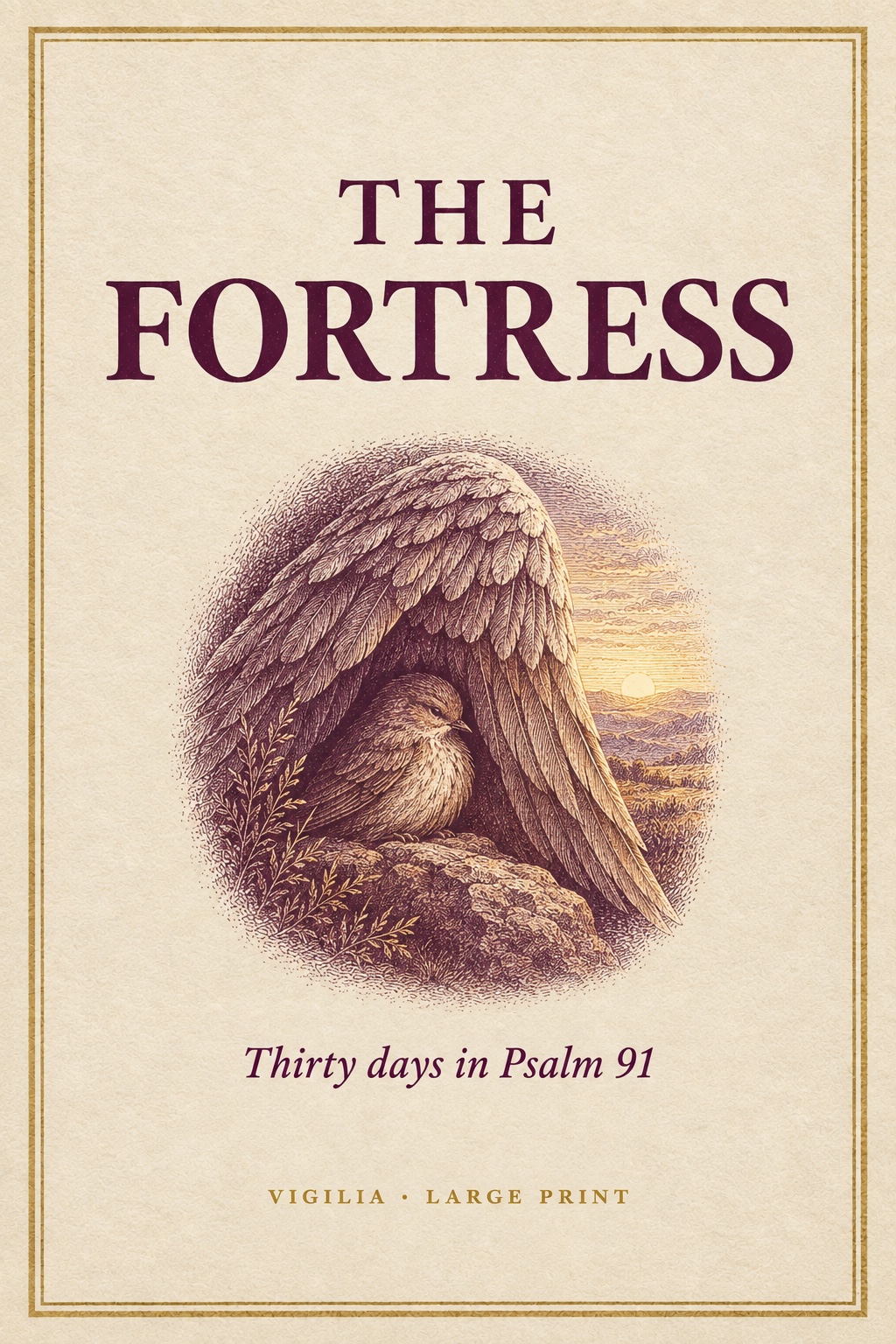
- He shall cover thee with his feathers A bird sheltering young under a wing. The most domestic image in the psalm sits at its centre, and it is a picture of something small being covered by something larger, not of the storm being called off.
- Thou shalt tread upon the lion and the adder The lion is power you can see coming; the adder is what you step on without noticing. Again a pair, again meaning the whole range.
The ending is the part nobody quotes
The last three verses change speaker. Up to verse fourteen the psalm has been describing God in the third person. Then God speaks: because he has set his love upon me, I will deliver him. And what follows is not a list of things prevented. It is 'I will be with him in trouble' — trouble assumed, presence promised inside it.
That single line is the psalm's own answer to how it should be read. Not trouble avoided. Trouble accompanied. Every video that turns Psalm 91 into a guarantee has to skip verse fifteen to do it.
Read whole, it is a harder and much better text than the version in circulation. It does not tell you nothing will happen. It tells you where you are while it does.